 Image 1 of 1
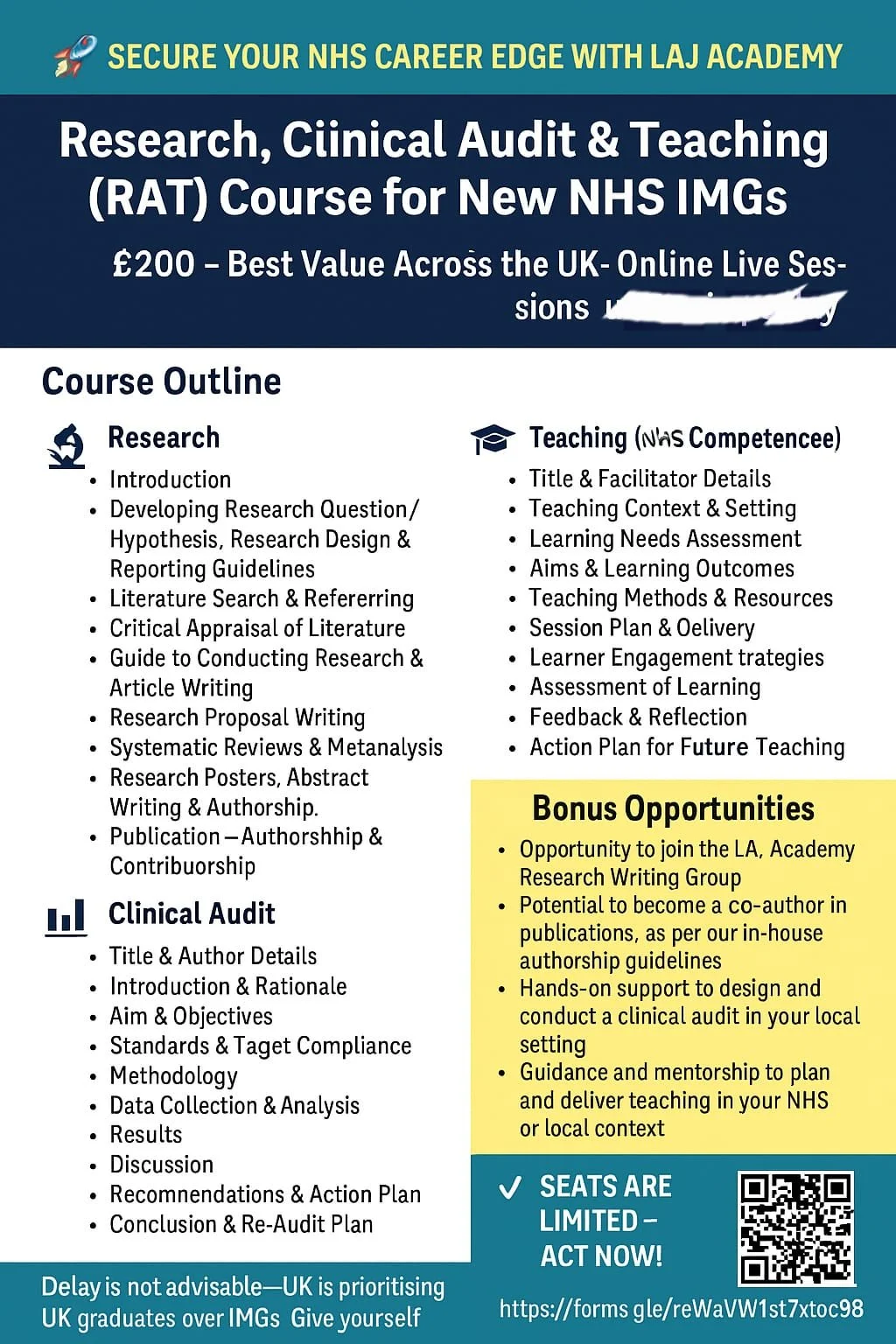
Research, Audit & Teaching(RAT) Course for IMGs
🔍 Overview of the RAT Programme (Research, Audit & Teaching)
The Research, Audit & Teaching (RAT) Course is a structured professional development programme designed to equip doctors—particularly IMGs—with the core academic, clinical governance, and educational competencies expected within the NHS.
It is built around three key pillars:
🔬 Research Competency
From developing research questions to publication and conference presentation
Covers systematic reviews, meta-analysis, and critical appraisal
Emphasises authorship ethics, reporting standards, and academic writing
👉 Outcome: Ability to contribute to high-quality research, publish work, and build a strong academic portfolio.
📊 Clinical Audit Mastery
Full audit cycle: planning → data collection → analysis → implementation → re-audit
Focus on quality improvement, governance, and measurable impact
Teaches standards, compliance, and actionable change
👉 Outcome: Demonstrate involvement in NHS quality improvement—essential for appraisal, ARCP, and training applications.
🎓 Teaching & NHS Educational Competence
Structured approach to teaching design and delivery
Includes Gagné’s Nine Events, learning theories, and assessment strategies
Covers feedback, reflection, and portfolio development
👉 Outcome: Build evidence for teaching experience, a key domain in NHS job and training applications.
🚨 Why IMGs Should Do RAT Courses (Especially Now)
1. The Era of Medical Prioritisation in the UK
The UK is currently experiencing increased competition for training posts and jobs, driven by:
Expansion of UK medical school graduates
Prioritisation policies favouring local graduates
Rising number of IMGs entering the NHS
👉 This means clinical experience alone is no longer enough.
2. Portfolio Is Now the Deciding Factor
For competitive roles (e.g. ST3, ACF, fellowships), success depends heavily on:
Research & publications
Completed clinical audits (with re-audit ideally)
Teaching experience with evidence
Leadership and quality improvement
👉 RAT directly addresses all three high-yield portfolio domains.
3. IMGs Often Start at a Disadvantage
Many IMGs:
Have limited exposure to NHS audit cycles
Lack of familiarity with UK research expectations
Have teaching experience, but without structured documentation
👉 RAT bridges this gap by:
Translating prior experience into UK-recognised competencies
Teaching how to evidence achievements properly
4. Aligns with NHS Appraisal & ARCP Requirements
Within the NHS, progression requires:
Demonstration of quality improvement (audit/QI projects)
Evidence of teaching and feedback
Engagement with research or academic activity
👉 RAT ensures IMGs can meet these requirements early, avoiding delays in progression.
5. Increases Competitiveness for Training Posts
For applications such as:
Core Training / Speciality Training (e.g. ST3 Vascular Surgery)
Academic Clinical Fellowships (ACF)
Clinical Fellow roles
👉 Candidates with:
Publications
Completed audits
Structured teaching
…consistently outperform those without.
6. Builds Confidence and Professional Identity
Beyond the CV, RAT helps IMGs:
Speak confidently about research, audit, and teaching in interviews
Understand NHS culture and expectations
Transition from “service provision” to a career progression mindset
🧠 Bottom Line
In today’s NHS landscape, IMGs must move from simply working clinically to building a competitive portfolio.
The RAT course is not just a training programme—it is a strategic career accelerator that enables IMGs to:
Demonstrate academic credibility
Contribute to patient safety and quality improvement
Develop as educators and future leaders
🔍 Overview of the RAT Programme (Research, Audit & Teaching)
The Research, Audit & Teaching (RAT) Course is a structured professional development programme designed to equip doctors—particularly IMGs—with the core academic, clinical governance, and educational competencies expected within the NHS.
It is built around three key pillars:
🔬 Research Competency
From developing research questions to publication and conference presentation
Covers systematic reviews, meta-analysis, and critical appraisal
Emphasises authorship ethics, reporting standards, and academic writing
👉 Outcome: Ability to contribute to high-quality research, publish work, and build a strong academic portfolio.
📊 Clinical Audit Mastery
Full audit cycle: planning → data collection → analysis → implementation → re-audit
Focus on quality improvement, governance, and measurable impact
Teaches standards, compliance, and actionable change
👉 Outcome: Demonstrate involvement in NHS quality improvement—essential for appraisal, ARCP, and training applications.
🎓 Teaching & NHS Educational Competence
Structured approach to teaching design and delivery
Includes Gagné’s Nine Events, learning theories, and assessment strategies
Covers feedback, reflection, and portfolio development
👉 Outcome: Build evidence for teaching experience, a key domain in NHS job and training applications.
🚨 Why IMGs Should Do RAT Courses (Especially Now)
1. The Era of Medical Prioritisation in the UK
The UK is currently experiencing increased competition for training posts and jobs, driven by:
Expansion of UK medical school graduates
Prioritisation policies favouring local graduates
Rising number of IMGs entering the NHS
👉 This means clinical experience alone is no longer enough.
2. Portfolio Is Now the Deciding Factor
For competitive roles (e.g. ST3, ACF, fellowships), success depends heavily on:
Research & publications
Completed clinical audits (with re-audit ideally)
Teaching experience with evidence
Leadership and quality improvement
👉 RAT directly addresses all three high-yield portfolio domains.
3. IMGs Often Start at a Disadvantage
Many IMGs:
Have limited exposure to NHS audit cycles
Lack of familiarity with UK research expectations
Have teaching experience, but without structured documentation
👉 RAT bridges this gap by:
Translating prior experience into UK-recognised competencies
Teaching how to evidence achievements properly
4. Aligns with NHS Appraisal & ARCP Requirements
Within the NHS, progression requires:
Demonstration of quality improvement (audit/QI projects)
Evidence of teaching and feedback
Engagement with research or academic activity
👉 RAT ensures IMGs can meet these requirements early, avoiding delays in progression.
5. Increases Competitiveness for Training Posts
For applications such as:
Core Training / Speciality Training (e.g. ST3 Vascular Surgery)
Academic Clinical Fellowships (ACF)
Clinical Fellow roles
👉 Candidates with:
Publications
Completed audits
Structured teaching
…consistently outperform those without.
6. Builds Confidence and Professional Identity
Beyond the CV, RAT helps IMGs:
Speak confidently about research, audit, and teaching in interviews
Understand NHS culture and expectations
Transition from “service provision” to a career progression mindset
🧠 Bottom Line
In today’s NHS landscape, IMGs must move from simply working clinically to building a competitive portfolio.
The RAT course is not just a training programme—it is a strategic career accelerator that enables IMGs to:
Demonstrate academic credibility
Contribute to patient safety and quality improvement
Develop as educators and future leaders